

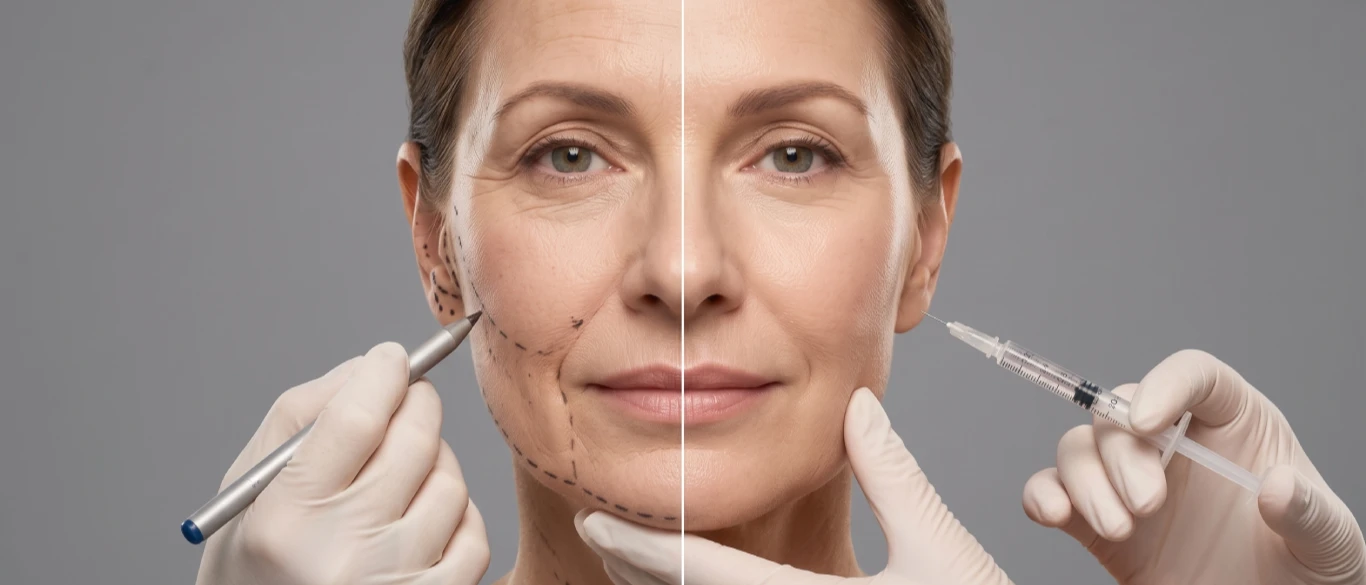
Facelift vs Dermal Fillers: Which Gives Better Results?
When facial ageing begins to change the way you see yourself, the first question is often not about a particular procedure. It is about what kind of change you actually need. Is your face looking flatter because of volume loss? Are your cheeks and jawline beginning to sag? Have deeper folds appeared around the mouth? Or is it a combination of several changes?
At DesignerBodyz, Dr. Parag Telang, a leading plastic and cosmetic surgeon in Mumbai, approaches facial rejuvenation by looking at the underlying cause of these changes rather than treating every sign of ageing in the same way. This is particularly important when comparing a facelift with dermal fillers, because the two procedures work very differently.
Dermal fillers primarily restore volume, improve contours and soften certain lines and hollows. A facelift, on the other hand, is a surgical procedure designed to address facial laxity, sagging and changes in the position of tissues.
So, which gives better results?
There is no standard answer that applies to everyone. The more useful question is which treatment is appropriate for the specific changes you want to address.
What Is the Difference Between a Facelift and Dermal Fillers?
Although both treatments are used for facial rejuvenation, they work on different aspects of facial ageing.
A facelift, also called rhytidectomy, involves surgically repositioning facial tissues and removing or managing excess skin to improve sagging in areas such as the cheeks, jawline and lower face. Depending on the technique, the neck may also be addressed.
Dermal fillers are injectable products placed beneath or within the skin to restore lost volume, enhance facial contours and soften certain wrinkles and folds. Different fillers have different properties and are selected according to the treatment area and desired result.
In simple terms:
Facelift = repositioning and tightening of ageing facial tissues
Dermal fillers = restoring volume and enhancing facial contours
That difference is the foundation of the entire comparison.
Facelift vs Dermal Fillers: What Can They Treat?
A facelift is particularly relevant when the primary concern is laxity and sagging.
It may address:
- Sagging cheeks
- Jowls along the jawline
- Loose skin around the lower face
- Deepening folds associated with facial descent
- Loose or ageing skin around the neck, when combined with a neck lift
- Loss of definition around the jawline
However, a facelift does not correct every sign of facial ageing. Fine lines, pigmentation, sun damage and changes in skin texture may require separate treatments.
Dermal fillers are more focused on volume and contour.
They can be used for concerns such as:
- Hollow cheeks
- Temple volume loss
- Under-eye hollows in appropriately selected patients
- Nasolabial folds
- Marionette lines
- Lip volume and definition
- Certain facial contour irregularities
- Loss of definition in selected facial areas
Fillers therefore have a different role. They can restore fullness that has been lost with age, but they cannot physically remove substantial excess skin.
Facelift vs Dermal Fillers: Results and Longevity
One of the biggest differences is how long the results are expected to remain.
Dermal fillers are not generally permanent. Their longevity depends on the type of filler, treatment area, metabolism and other individual factors. Many commonly used fillers gradually break down and are eventually absorbed by the body, meaning maintenance treatments may be required.
A facelift produces a longer-lasting structural improvement because it addresses sagging tissues surgically. However, it does not stop the ageing process. The face continues to age naturally after surgery, and the results will change over time.
Therefore, neither treatment should be viewed as freezing the face at a particular age.
The distinction is better understood as:
| Factor | Facelift | Dermal Fillers |
| Nature of Treatment | Surgical | Injectable |
| Main Purpose | Addresses sagging and tissue laxity | Restores volume and enhances contours |
| Excess Skin | Can address excess skin | Cannot remove excess skin |
| Volume Loss | May be combined with fillers/fat transfer | One of the main indications |
| Downtime | Longer recovery period | Usually relatively short |
| Incisions | Required | No surgical incisions |
| Results | Longer-lasting structural change | Temporary and maintenance-based |
| Repeat Treatment | Not routinely repeated at short intervals | Often requires maintenance |
| Best Suited To | More significant laxity and sagging | Volume loss and selected lines/contours |
Facelift or Dermal Fillers - Which One Is More Suitable for Sagging Skin?
This is one of the clearest areas of difference.
If the primary problem is loss of facial volume, fillers may be considered.
If the primary problem is significant skin laxity and tissue descent, a facelift may be considered.
For example, someone may have relatively good skin tightness but notice that the cheeks have become hollow and the temples look more sunken. Restoring volume may address the visual concern.
Another person may have developed pronounced jowls and loose skin along the jawline. Adding volume alone may not address the underlying tissue laxity, and a surgical consultation may therefore be more appropriate.
There can also be patients with both volume loss and sagging. In such situations, a surgeon may recommend a combination of approaches rather than treating one problem in isolation.
Recovery: Facelift vs Dermal Fillers
Recovery is another major consideration.
After dermal fillers, temporary swelling, bruising, tenderness or redness can occur. These effects generally settle over the following days, although the exact recovery period varies according to the product and treatment area.
Facelift recovery is considerably more involved. Swelling and bruising are expected after surgery, and patients need time for incisions and deeper tissues to heal. The final appearance also develops gradually rather than immediately.
This makes the decision about treatment partly a lifestyle decision. Someone who wants minimal interruption to work and daily activities may have very different priorities from someone seeking a more substantial surgical correction and is prepared for a longer recovery.
Are Dermal Fillers Safer Than a Facelift?
It is better not to describe either procedure as completely risk-free.
Because fillers are minimally invasive, they generally involve less recovery than surgery. However, injections still carry risks such as swelling, bruising, infection and changes in contour. Rare but serious complications can occur if filler enters a blood vessel, which is why facial fillers should be administered by an appropriately qualified medical professional with a strong understanding of facial anatomy.
A facelift carries the risks associated with surgery, including bleeding, infection, scarring, wound-healing problems and, rarely, nerve-related complications.
The risk profile is therefore different rather than simply a matter of one procedure being “safe” and the other being “unsafe.”
Can Fillers and Facelift Surgery Be Combined?
Yes. In some patients, these treatments can have complementary roles.
A facelift can address sagging and reposition facial tissues, while fillers or fat transfer may subsequently be considered to restore specific areas of lost volume.
The combination depends on facial anatomy, the extent of ageing and the patient's goals. It is not necessary or appropriate for everyone.
This is also why choosing a treatment based solely on age is not ideal. Two people of the same age can have very different patterns of facial ageing.
Facelift vs Dermal Fillers: What Should You Consider?
Instead of asking which treatment is universally better, consider these questions:
What is actually bothering you?
Is it hollowing, wrinkles, loss of contour, jowls, loose skin or several concerns together?
How much correction are you looking for?
Subtle volume restoration and a structural lift are fundamentally different goals.
How much downtime can you accommodate?
Fillers generally involve considerably less recovery than facelift surgery.
Are you comfortable with ongoing maintenance?
Fillers typically require repeat treatment as their effects diminish.
Do you have significant skin laxity?
If excess skin and tissue descent are major concerns, fillers may not address the underlying problem.
What does your facial anatomy allow?
A qualified surgeon should assess your face rather than recommending a procedure based solely on a photograph or age.
So, Which Gives Better Results - Facelift or Dermal Fillers?
There is no universal winner between a facelift and dermal fillers because they are designed to solve different problems.
A facelift is a surgical approach to facial ageing that primarily addresses sagging, tissue laxity and excess skin. Dermal fillers are minimally invasive treatments that primarily address volume loss, selected folds and facial contour.
For some people, restoring lost volume may be all that is required. For others, particularly those with more pronounced laxity, surgery may be considered. And in certain cases, a combination of surgical and non-surgical treatments may provide a more comprehensive approach.
At DesignerBodyz, Dr. Parag Telang can assess the pattern of facial ageing, skin laxity, volume loss and individual aesthetic goals before discussing the available options. The objective is not to choose the more intensive treatment, but to identify an approach that matches the actual problem being treated.
Ultimately, the right treatment is determined by what is changing in your face, not simply by your age or by which procedure is more popular.
FAQs about Facelift vs Dermal Fillers
Are dermal fillers the same as a facelift?
No. Dermal fillers are injectable treatments used primarily to restore volume and improve selected facial contours and lines. A facelift is a surgical procedure that addresses sagging and repositioning of facial tissues.
Can fillers replace a facelift?
Fillers can provide facial rejuvenation in appropriately selected patients, but they cannot remove excess skin or surgically reposition significantly sagging tissues. Therefore, they cannot reproduce every aspect of a facelift.
How long do dermal fillers last?
The longevity varies according to the filler used, treatment area and individual factors. Many commonly used fillers are temporary and gradually break down, so maintenance treatments may be needed.
How long do facelift results last?
A facelift produces a longer-lasting change than temporary injectable fillers, but it does not stop natural ageing. The face continues to change over time after surgery.
Can I have fillers after a facelift?
In some cases, yes. Fillers may be considered to address residual or subsequent volume loss after facelift surgery. The timing and suitability should be determined by the treating surgeon.
How do I know whether I need fillers or a facelift?
A consultation with a qualified plastic surgeon is the most appropriate way to determine this. The assessment should consider skin laxity, facial volume, tissue descent, facial anatomy, overall health, expectations and the amount of downtime you are comfortable with.
About the Author


