

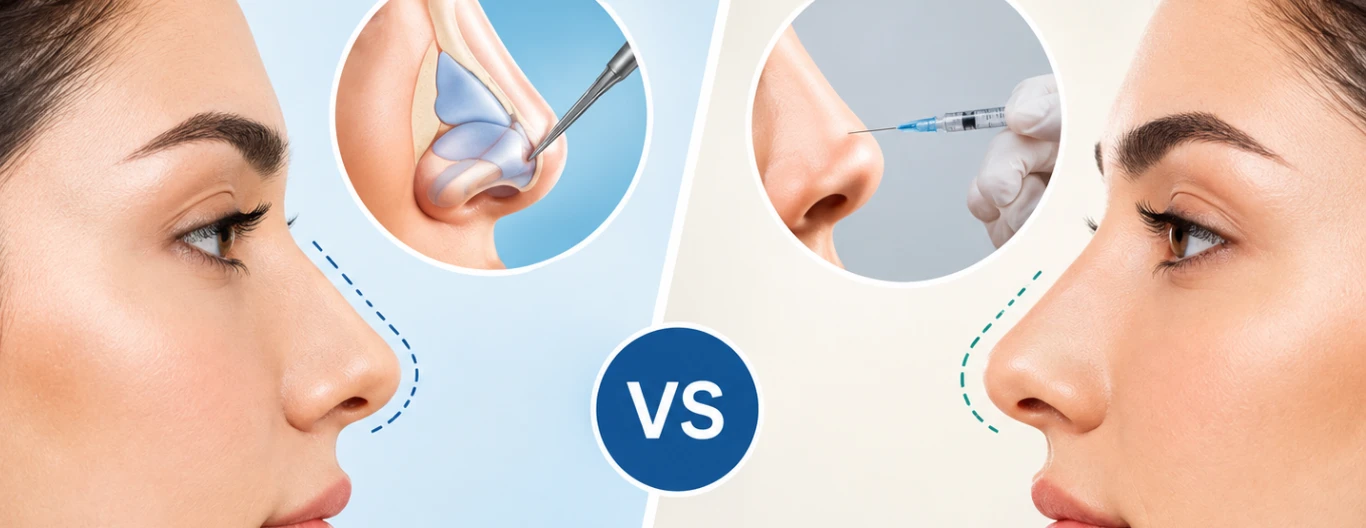
Rhinoplasty vs Non-Surgical Nose Job: Which Is Better?
The nose plays a surprisingly powerful role in facial harmony. Even a small change in its shape, projection, or proportion can influence how the entire face appears. That is why people considering nose reshaping often find themselves comparing two very different approaches: surgery that changes the underlying structure and injectable treatment that creates a temporary visual refinement.
At Designer Bodyz in Mumbai, Dr. Parag Telang, a qualified plastic and cosmetic surgeon, offers expertise in facial aesthetic procedures including rhinoplasty. For those looking for a preferred plastic surgeon in Mumbai, understanding the surgeon's approach, experience and ability to assess individual facial proportions is just as important as understanding the procedure itself.
Rhinoplasty vs Non-Surgical Nose Job: Understanding the Difference
The simplest way to understand rhinoplasty vs non surgical nose job is to look at how each procedure changes the nose.
Rhinoplasty is a surgical procedure that can alter the underlying bone, cartilage and soft tissue of the nose. Depending on the patient's concerns, the procedure can reshape, reduce, refine, or reposition specific nasal structures.
A non-surgical nose job, commonly called a liquid rhinoplasty, uses injectable dermal fillers to modify the appearance of the nose. Instead of removing or surgically reshaping tissue, filler is strategically placed to add volume and create a more balanced contour.
So while both can improve the appearance of the nose, they are fundamentally different procedures with different possibilities, limitations, recovery periods and longevity.
What Is Rhinoplasty?
Rhinoplasty, popularly known as a nose job, is a surgical procedure performed to change the shape, size, proportions, or structure of the nose.
Depending on the individual's anatomy and desired outcome, rhinoplasty may involve modifications to the nasal bones, cartilage, septum, or nasal tip. The procedure can be performed for aesthetic reasons, functional concerns, or a combination of both.
Some concerns that may be addressed through rhinoplasty include:
- A prominent dorsal hump
- A broad nasal bridge
- A bulbous or poorly defined tip
- A drooping nasal tip
- Nasal asymmetry
- Certain structural deformities
- Proportion or size concerns
- Selected breathing difficulties associated with structural issues
One of the defining features of rhinoplasty is its ability to change the underlying framework of the nose, rather than simply altering its surface appearance.
What Is a Non-Surgical Nose Job?
A non-surgical nose job is an injectable procedure generally performed using dermal fillers.
Rather than removing tissue or altering the nasal skeleton, the surgeon strategically introduces filler into carefully selected areas to create a smoother or more proportionate appearance.
For instance, adding a small amount of filler around a dorsal irregularity may make the profile appear straighter. Similarly, carefully placed filler may enhance definition in selected areas of the bridge or tip.
However, there is an important distinction to remember:
A liquid rhinoplasty adds volume; surgical rhinoplasty can remove, reshape, or reposition structural components.
That difference determines which concerns each treatment can realistically address.
Rhinoplasty vs Non-Surgical Nose Job: Key Comparison
| Factor | Rhinoplasty | Non-Surgical Nose Job |
| Procedure Type | Surgical | Injectable |
| Main Approach | Reshapes nasal structures | Adds strategic volume |
| Changes Bone/Cartilage | Possible | No |
| Can Reduce Nasal Tissue | Yes, depending on the surgical plan | No |
| Results | Long-lasting | Temporary |
| Downtime | Longer recovery | Usually minimal downtime |
| Anaesthesia | Depends on surgical technique | Usually local/topical numbing |
| Degree of Correction | Can address structural concerns | Generally suited to selected contour refinements |
| Maintenance | Usually not routine | Repeat treatment may be required |
| Functional Correction | May be incorporated when appropriate | Not designed to correct structural airway problems |
| Revision | Revision surgery may sometimes be required | Treatment can be adjusted or repeated depending on filler used |
Neither procedure exists as a universal solution. The more useful question is whether the technique is appropriate for the specific concern.
What Can Rhinoplasty Achieve?
Because rhinoplasty works on the underlying nasal framework, it offers a broader range of structural possibilities.
For someone with a prominent hump, for example, the surgeon may be able to modify the underlying structure rather than camouflage it. Similarly, concerns involving the nasal tip, bridge width, projection, or certain asymmetries can potentially be addressed surgically.
Rhinoplasty can also be planned with facial proportions in mind. A nose should not be assessed in isolation because its relationship with the forehead, cheeks, lips, chin and overall facial structure contributes to the final appearance.
This is where surgical planning becomes particularly important. The goal is not necessarily to create a “perfect” nose, but to create a nose that looks naturally proportionate to the rest of the face.
What Can a Non-Surgical Nose Job Achieve?
A non-surgical nose job can be useful when the desired change is relatively subtle and can be achieved through strategic filler placement.
Depending on the individual's anatomy, it may help:
- Smooth the appearance of certain irregularities
- Create a straighter-looking nasal profile
- Add definition to selected areas
- Improve the appearance of minor asymmetries
- Refine certain contours
But there are clear limitations.
Because filler adds volume, it cannot physically remove a nasal hump, reduce the width of nasal bones, or reposition cartilage. In some situations, adding volume may even make the nose appear larger rather than smaller.
Therefore, expectations need to be realistic before choosing a liquid rhinoplasty.
Which One Has Longer-Lasting Results?
This is another major difference when comparing rhinoplasty vs non surgical nose job.
Rhinoplasty is intended to produce long-lasting structural changes. The nose will continue to age naturally and its appearance can evolve over time, but the surgical modifications themselves are generally considered long-term.
Non-surgical nose reshaping is temporary. Dermal fillers are gradually broken down by the body, meaning the effects eventually diminish. The duration can vary depending on the filler used, the treatment area, individual metabolism and other factors.
Someone considering either procedure therefore needs to think beyond the immediate result and consider their expectations for the years ahead.
What About Recovery?
Recovery can look quite different between the two treatments.
After rhinoplasty, swelling, bruising, tenderness and temporary changes in the appearance of the nose are common. While much of the visible swelling settles gradually, the nose can continue refining as healing progresses.
A non-surgical nose job generally involves significantly less downtime. Mild swelling, redness, tenderness, or bruising can occur following injections, but many people are able to resume their usual activities relatively quickly.
However, less downtime does not mean zero risk.
Is a Non-Surgical Nose Job Risk-Free?
No cosmetic procedure should be considered completely risk-free.
The nose has an intricate network of blood vessels, making filler injection a technically demanding procedure. Although uncommon, complications such as vascular occlusion, tissue damage and visual complications can occur if filler enters or compromises a blood vessel.
Rhinoplasty, meanwhile, carries risks associated with surgery, including infection, bleeding, anaesthesia-related complications, asymmetry, dissatisfaction with the result and the possibility of revision surgery.
This makes the experience and judgement of the treating professional particularly important, regardless of whether the procedure involves a scalpel or a syringe.
How Do You Decide Between the Two?
The decision should begin with the problem you want to solve, rather than the procedure you have already chosen.
If your concern involves the underlying structure of the nose, surgical rhinoplasty may need to be considered. If you are looking for a subtle contour adjustment that can be achieved through adding volume, a non-surgical approach may be an option.
Your skin thickness, cartilage, bone structure, facial proportions, previous procedures, medical history, breathing concerns and expectations can all influence the recommendation.
This is why an experienced cosmetic surgeon in Mumbai should assess your nose in person before suggesting a treatment.
Why Your Choice of Surgeon Matters
A surgeon needs to understand nasal anatomy, facial proportions, surgical limitations and the patient's aesthetic expectations. They also need to know when a particular procedure is not appropriate.
At Designer Bodyz, Dr. Parag Telang expertises in aesthetic and reconstructive plastic surgery, including facial aesthetic procedures and rhinoplasty. His qualifications include MBBS, MS in General Surgery and MCh in Plastic Surgery, along with additional professional qualifications and training.
For anyone researching the best plastic surgeon in Mumbai, it is worth looking beyond rankings and online claims. A surgeon's qualifications, experience with the specific procedure, approach to patient selection, communication during consultation and consistency of results are all important considerations.
Rhinoplasty or Liquid Rhinoplasty: There Is No Universal Answer
The comparison between surgical and non-surgical nose reshaping ultimately comes down to what needs to change.
Rhinoplasty can modify the structure. Non-surgical rhinoplasty primarily modifies appearance through carefully placed volume. One involves surgery and a longer recovery; the other generally involves less downtime but temporary results. One can address certain structural concerns; the other has more limited applications.
At Designer Bodyz, patients can consult and discuss their concerns with Dr. Parag Telang and understand which options may be appropriate for their individual anatomy and expectations.
The most important takeaway is that there is no single procedure that is automatically right for everyone. The outcome depends on the individual's goals, anatomy, expectations and, above all, the expertise and judgement of the surgeon performing the procedure.
FAQs
1. At what age can someone consider rhinoplasty?
Rhinoplasty is generally considered after the nose has reached sufficient physical maturity. The appropriate age can vary between individuals and should be determined during a consultation.
2. Can rhinoplasty be performed after an injury to the nose?
Yes, rhinoplasty can sometimes be considered following nasal trauma. The surgical plan depends on the extent of structural changes, breathing issues and the amount of healing that has occurred.
3. Can a person choose between open and closed rhinoplasty?
Both are established surgical approaches and the choice depends on the complexity of the correction and the surgeon's assessment. The appropriate technique is determined on an individual basis rather than being universally preferable.
4. How should I evaluate a cosmetic surgeon before choosing one?
Look at recognised qualifications, relevant surgical experience, the type of procedures they regularly perform, patient reviews, before-and-after results and how thoroughly they discuss risks and realistic outcomes during consultation.
5. Is a second rhinoplasty possible if the first result is unsatisfactory?
Revision rhinoplasty is possible in selected cases, although it can be more complex because the anatomy has already been altered. The surgeon generally needs to assess healing, existing cartilage, scar tissue and the reason for the revision before recommending another procedure.
6. Does facial harmony matter when planning rhinoplasty?
Yes. The nose forms part of the overall facial structure, so its proportions and projection are generally assessed in relation to other facial features rather than independently.

